

Carry On And Keep Calm: Listen to Animals And Then Focus On These Five Calming Industry Signs
What I've listened to this summer: Howl, from Boise State Public Radio, Sharks! The mini series by Radiolab...and 5 things that make me feel calm about this burning industry

As I sit here at my desk typing, what keeps me sane are the crickets and cicadas, rising and falling like a long inhale and exhale. Most of my country (Canada) is blanketed in wildfire smoke; welcome to the new normal of climate change summers.
Last week there were four forest fires within 50Km of me; which is alarming, but the erosion of public media is burning faster than this Boreal forest. Too many stories about contraction—bordering on extinction—of this industry.
So much so that I feel compelled to focus on the mantra: Keep Calm and Carry On. It’s connection to wartime sloganeering is not lost on me.
The animals chirp and groan and slap outside, inside my headphones I’ve found two series about animals that are illuminating, problem-solving, and ready to swish you with a good tale.
[Scroll down find five calming industry signs]
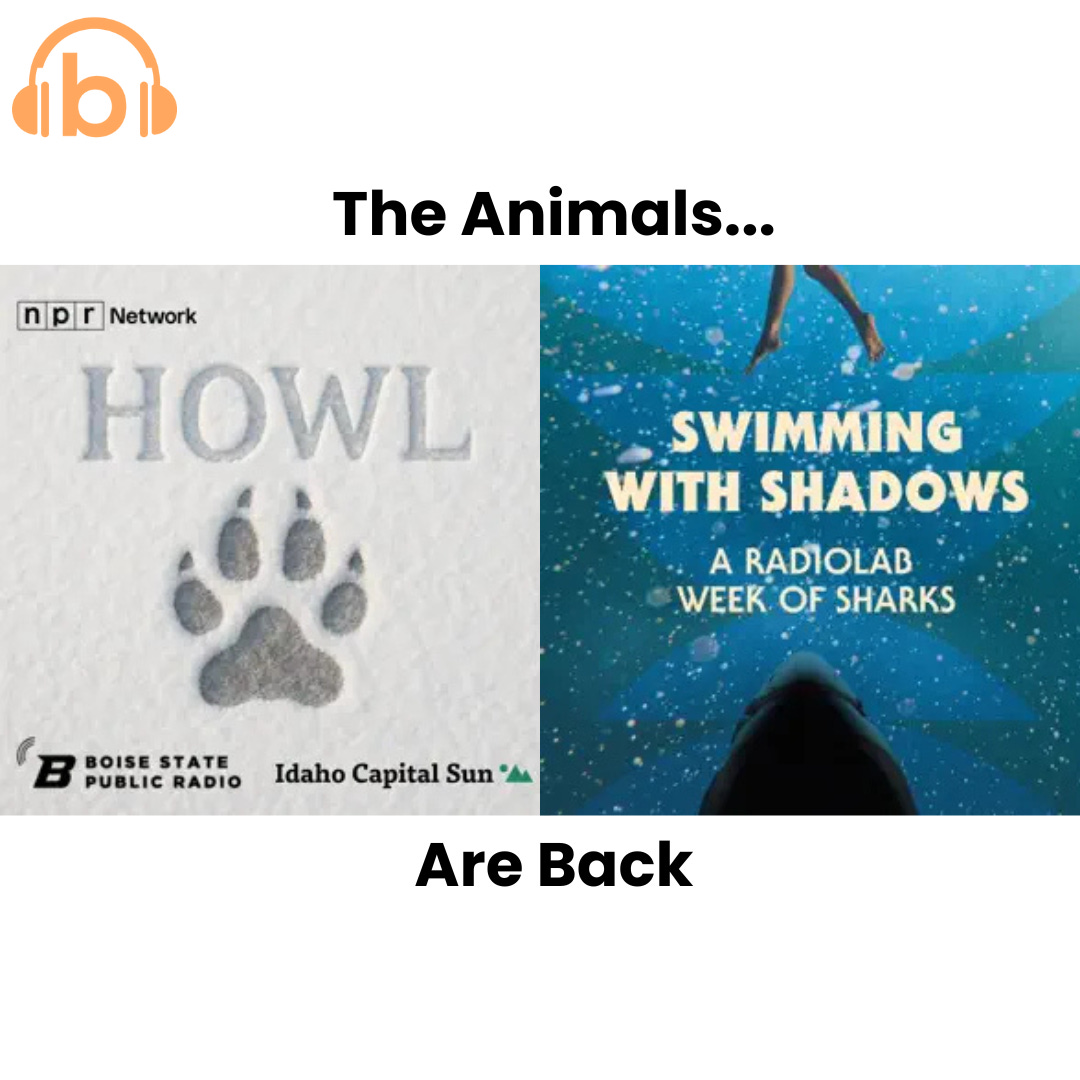
Howl - from Boise State Public Radio and the Idaho Capital Sun
If you’ve watched any of five seasons of Yellowstone, its origin story 1883, or its prequel 1923, Howl offers a different angle on the chapter heading Yellowstone. Although the series still touches on many classic themes — man versus beast; cowboys and Indians; science versus farmer; truth versus myth — it feels like a respite from the usual narratives of Western expansion, the Depression, The Great War and Prohibition.
At the centre is the beloved Yellowstone, America’s first National Park, a monumental landscape straddling three states and home to Indigenous peoples for over 11,000 years. But here, the star is the wolf — not the Duttons’ stallions or the grazing cattle of the Yellowstone Plateau with the mountains looming behind.
Howl becomes a tense and adversarial story (in a good way), but it begins with a calm walk into the forest. Host and co-reporter Heath Druzin opens with the dawn chorus, and then a walk in the forest and the haunting sound of the wolves howling in the distance. Just one minute into the story, and you are there, right where you want to be. If the producer rewards the listener with tape of the actual location, instead of dry facts or experts cawing on, it transcends the location, offers an experience and brings you inside. I was hooked by the third minute of this series.
Druzin opens by explaining how the Lamar Valley is the big show, and where he encountered wolves inside Yellowstone. We listen to them for a moment, and then he offers what wolves bring to the experience, and what they offer to humans. “Where you can truly be a visitor in the domain of the wild. But a familiarity too, a social animal with family bonds that looks similar to a lot of people's pets.”
And from here, Druzin explains, wolves are the defining flashpoint of Yellowstone
The reason, why everyone from a east coast city slickers to west coast elites all have a romantic notion of The West. And the idea that invisible boundaries of this massive tract of land, spanning almost 3,500 sq. miles (almost 9,000 km2 ) of land, can be tamed and controlled, is ludicrous.
But not everyone loves the wolves as much as the tourists and conservationists, which could be why they were hunted to near extinction. As you know from the Duttons, cattle (and the people who own them) are the economic driving force of this region. There’s also the elk and the bison, who are also part of the complicated balance that is required to keep an ecosystem in check.
This year marks the 30th anniversary of the return of the wolves to Yellowstone, after they were re-introduced from Canadian Grey Wolves that were trapped and relocated.
What I like most about this series is that Druzin gets out on the land and tracks the animals, both on land and through history. I appreciate that it’s Druzin who is framed in the cold open, and how his co-host Clark Corbin, part of the Idaho Capital Sun, the non-profit new organization who supported this expensive reporting effort, is introduced later and given a narration part in the series, but this funding partner allows there to be one host to lead the story, and not one host plus the other guy who helped to pay for it. I should also mention here that the show credits mention how it was also supported by The Corporation for Public Broadcasting, a private corporation that folded last month. Sigh. Another lightening strike in the forest.
The series is five episodes long, and does a fantastic job to outline all of the thorny issues that coincide with the idea of animals existing in the wild, alongside a domesticated animal (cattle), who are there to provide a livelihood for many (ranchers), who are trying to coexist with the Indigenous people who have their own ideas about wolves (they are family), while meanwhile trying to maintain an experience for tourists and travellers, who aside from ranching are the key industry of Yellowstone (tourism).
This kind of story makes for an excellent investigative podcast, because there’s no exactly right answer. Many voices, ways of seeing, belief systems and livelihoods need to be heard to wrap your mind around this issue.
Enjoy this modern day parable about how to balance nature vs human, human vs beast, scientist vs rancher. It’s fodder to think about how to achieve balance in our climate-changing uncertain future, and makes for an engaging listen.
Sharks! Radiolab mini series
It’s hard not to feel old saying this, but this summer marks 50 years since the genre-defining film Jaws, Steven Spielberg’s first of many blockbuster films.
As an ode to that landmark, and as a way to be mindful of these precious, incredible dinosaurs, Radiolab decided to set aside an entire week of programming dedicated to Sharks! The series covers the lasting cultural impact of the film and what it hath rot, from conservation efforts, historical tidbits, to various other amazing and little known shark facts (their potential to cure cancer, the unlikely photographer connection to the image of the monster, the list goes on).
Hot take on the cultural legacy of this kitschy film
When I was a kid swimming in fresh water lakes, a very long way from any ocean, I remember wearing a snorkel and a mask. If I saw a fish, I would immediately hyperventilate and have to come up to the surface to breathe, because, well, it could be a shark. The terror was real, folks. Two decades later, I was at SXSW when they offered tickets to watch the film Jaws while floating on a lake in an innertube. No amount of level-headed thinking could get me into that water. Two decades hence, I learned to scuba dive, and on my very first descent into the ocean, a shark was waiting for me. I’m certain the only reason I didn’t freak out and bolt up to the surface was because of the deep meditating I had done about the beauty and the importance of sharks prior to this moment.
I am definitely part of the lost generation of those kids who were spoiled, if not completely ruined, by Jaws, and desperately in need of re-programming. Which makes this mini series by RadioLab a sort of proximity therapy on my path to rehabilitation.
Whether or not you’re in need of this reintroduction therapy, the Sharks! Mini-series form RadioLab is well worth your time. The series is friendly and chippy, well suited for family road trip listening, if you can peel the headphones off your children and all listen to the same story over the car speakers (gasp, does that still happen?!)
That RadioLab technique of being upbeat and humorous, while finishing each other’s sentences fits well with this topic. Sometimes this frenetic style grates on me and feels out of place with the subject matter at hand. But for this it works well. So if you’re in the mood for a fast-moving, upbeat, fun and insightful series, fun for the whole family, reach for this one.
I’m still in awe of how these Radiolab producers can create the wall-to-wall sound design. The sophistication it takes to design a show where 2-3 people often complete the same sentence is insane. It’s the kind of technique that many people have tried, but few have mastered. Think about the layers:
The pacing needs to be consistent between all the people speaking
Then also the tone of their voice needs to match
The pacing of the sound that beds down beneath needs to be at the same or sympathetic frequency (and quite often, this sound is actually multiple layers built to sound like one).
The narration itself needs to lend itself to open-ended sentences and easy-to-complete thoughts.
The performance of the hosts and guests need to consistent (two hosts plus a third and sometimes fourth reporter…that’s a lot of people)
The delivery of these words needs to be clear and concise, but also sell the act that allows for the ducking and weaving that completes the thought. It made me wonder whether when they record the show if they actually instruct people to complete the sentences, and then chop them off later in post (to get other people to complete the thought). The editing is so seamless when the second person interjects. It never sounds like they stopped one word short in their delivery.
Dive in! First for the great shark tale (and the ending moment with Baby Shark), but then stay for the style and the syntax. It’s truly their signature work, and it’s done to perfection here.
5 Positive Industry Signs That Keep Me Calm Right Now
1 - Written in Air
- It’s a new audio magazine! It’s not a podcast, but it’s definitely innovative audio. Available in both cassette and vinyl as digital…and also in paper form (which is a production feat all on its own). You can buy it all on Bandcamp — such a smart business design!Each week the different tracks are described on the free tier - Subscribe to listen and hear more.
2 - Adopt a Station
Some reacted more adroitly than others pace to the Boreal forest burn that is the public podcasting industry. Take
, who took his data, his reach through his Substack semipublic.co and then he got the Adopt a Station off the ground. Adopt a Station has spread around LinkedIn like a good fire (at the time of writing there were 753 reposts and 1,600 comments).Pledge. Support. Restore. Public media in America has never faced a problem like this before. Go ahead….Adopt a Station
3 - Audio Flux
Knit one, flux two…love this catch phrase. I keep repeating myself here about Audio Flux, but it’s just so nice to see this outta-the-box creativity when it comes to this industry. It’s this kind of building block that makes it feel like we can build back stronger.
Audio Flux - submit by September 15
4 - (( XMTR )) Audio Arts Festival
XMTR returns for its second year. Located in the incredibly beautiful St. Leonards by the Sea, East Sussex, UK. September 26-28, 2025. Details and schedule up now.
It’s a gathering to remind folks of the art in audio. A gathering of like minds, and ears. Come find performances and deep listening experiences. Festival passes start at £97.56
5 - Essential Listening Poll
Ever wondered what would happen if you asked all the people you know (or want to know) in this industry what their seminal podcast works are? What would your top 5 influences and audio loves be?
Well, we know this now.
Just launched in paper format at Podcast Movement by Left of Dial, see what the TOP 100 shows are HERE
And if you want the redux version, what I think this list means, check out my introduction to the list: WHAT THEY SAID: THE TOP 100 PODCASTS EVER MADE ACCORDING TO THE PEOPLE THAT MADE THEM
I love that you found some amazing animal related podcasts to recommend! I am looking forward to enjoying them:)